When Haute Couture Meets the Mineral Kingdom
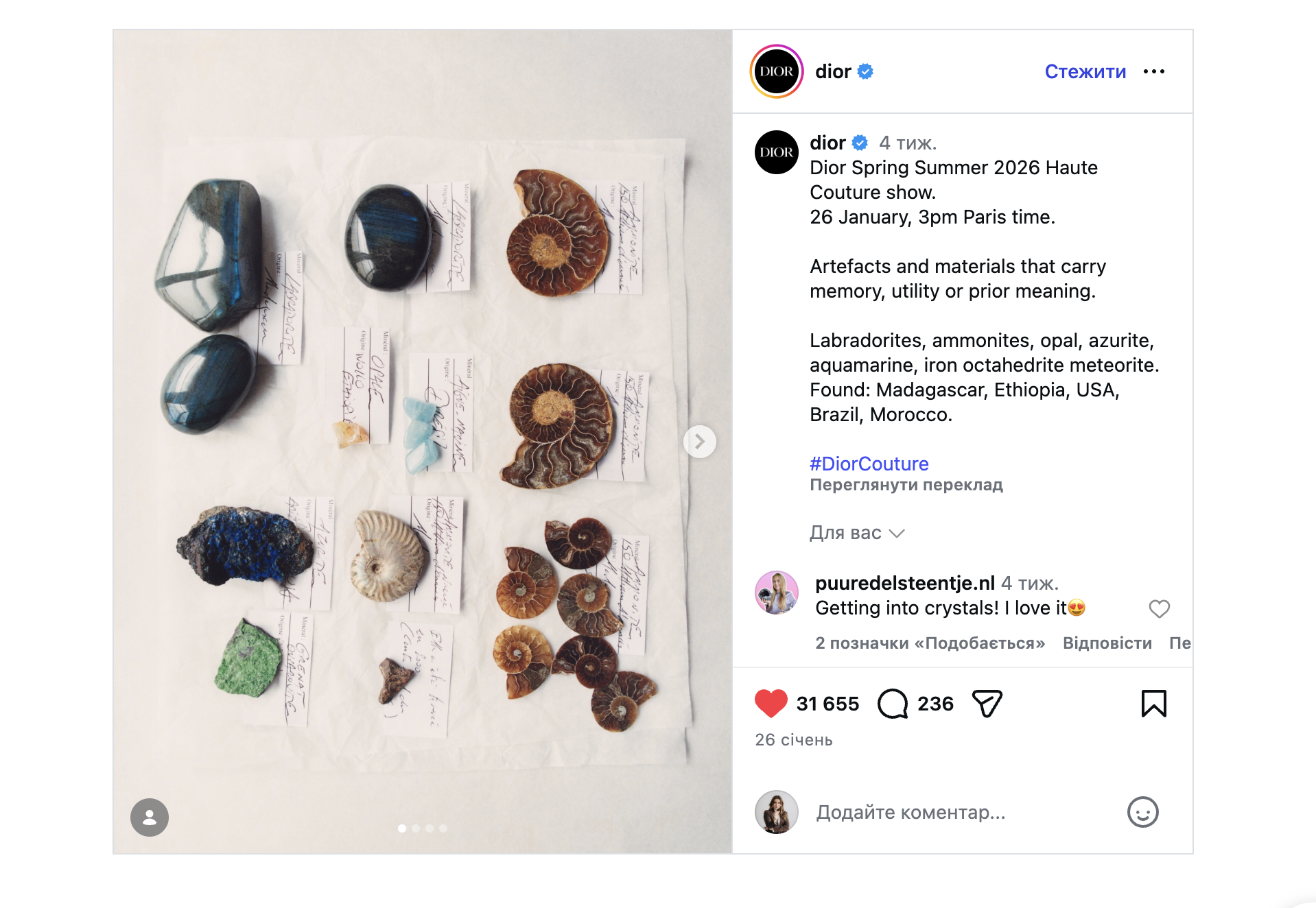
On January 26, 2026, Jonathan Anderson presented his debut Haute Couture collection for Dior at the Musée Rodin in Paris. The collection, titled Objects of Wonder (https://www.instagram.com/p/DUEPRnViE3g/?img_index=1 ), placed minerals, fossils, and meteorites at the centre of one of the world's most prestigious fashion houses. Labradorites, ammonites, azurite, opal, aquamarine, and iron meteorite were integrated directly into the jewellery, carved and mounted as chunky cuffs and statement rings, displayed alongside the garments as creative equals.
For the mineral world, this is a significant moment. The quiet, dedicated work of mineral collectors, museum curators, rock hunters, and research scientists, people who spend years studying, sourcing, and cataloguing specimens, has found its recognition at the highest level of creative culture. What mineralogists and gemologists have always known is now on full display. Natural specimens are among the most captivating objects on earth.
source: https://www.instagram.com/p/DT9_xwUCOUj/?img_index=1
Nature as Luxury
Dior's collection reflects a broader cultural shift. Collecting natural specimens has become a defining trend in luxury lifestyle. High-end interior designers integrate minerals as centrepiece objects. Flagship stores of luxury brands now create dedicated display cabinets, modern-day Wunderkammern (cabinets of curiosities), where curated mineral collections sit alongside art and design pieces.
The original Wunderkammern of the Renaissance were private collections assembled by scholars and aristocrats. Rooms of natural specimens, fossils, and scientific instruments, precursors to our modern museums. Anderson revives this spirit at Dior, treating minerals not as decorative afterthoughts but as creative catalysts, objects shaped over millions of years that carry memory and meaning. Nature, it turns out, is the ultimate luxury.
A Gemologist’s Guide to Dior’s Selection
Every specimen Dior featured is a well-known classic of the mineral collecting world. Here is what a gemologist sees when looking at their selection.
Labradorite (Feldspar Group)
A plagioclase feldspar, (Ca,Na)(Al,Si)₄O₈, known for its labradorescence, a play of iridescent blues, greens, golds, and violets caused by light refracting between internal twinning planes. Dior's specimens are from Madagascar, the premier source for large, polished freeform pieces with intense full-spectrum colour. Originally discovered in Labrador, Canada in 1770, also sourced from Finland (where the spectrolite variety shows especially vivid colours) and Ukraine. Polished labradorite is one of the most popular items at any mineral show.
Fun fact: Labradorite doesn't just occur as collector specimens. It forms massive intrusive rock bodies and is quarried as a dimension stone in Ukraine and Finland. It is used for interior and exterior cladding, countertops, and even for paving pedestrian roads. Imagine walking down a city street and seeing that blue-green iridescence flashing under your feet.
Ammonite Fossils
Fossilised cephalopods, relatives of the modern nautilus, that lived from roughly 240 to 66 million years ago, going extinct in the same mass extinction event that wiped out the dinosaurs. Their logarithmic spiral shell is one of the most iconic forms in natural history. Dior's specimens are from Madagascar, labelled as approximately 150 million years old (Jurassic period). Some Madagascan ammonites exhibit opalised or nacreous surfaces. Among the most widely available and affordable fossils on the market, and a perfect starting point for any collection.
Azurite
A copper carbonate hydroxide, Cu₃(CO₃)₂(OH)₂, with one of the most intense blues in the mineral kingdom. It was historically ground into pigment for Renaissance paintings. Often occurs alongside malachite, creating dramatic blue-green banded specimens. Dior lists Morocco among their sources; classic localities also include Chessy (France), Tsumeb (Namibia), and Bisbee (Arizona, USA).
Opal
A hydrated amorphous silica, SiO₂·nH₂O, with no crystal structure. Its famous play of colour arises from light diffracting through regularly arranged silica spheres. Dior references Ethiopia, which has become a major source of stunning play-of-colour opals, particularly from the Welo province. Ethiopian opal offers incredible beauty at accessible prices, and has transformed the market in recent years.
Aquamarine (Beryl Group)
The blue to blue-green variety of beryl, Be₃Al₂Si₆O₁₈, coloured by traces of iron. Shares its mineral family with emerald, morganite, and heliodor. Dior references Brazil, the world's most prolific source of gem-quality aquamarine, particularly from Minas Gerais. Other notable sources include Pakistan, Namibia, and Mozambique.
Iron Octahedrite Meteorite
An iron-nickel meteorite, a fragment of a protoplanetary body that travelled through space before reaching Earth. Iron octahedrites are the most common type of iron meteorite. The specimen featured by Dior is likely sourced from Agoudal, Morocco, a well-known fall site in the High Atlas mountains. Meteorite specimens are more accessible than most people expect and are regularly available from specialised dealers.
Closer Than You Think
What might surprise many people seeing Dior's campaign is that none of these specimens are particularly rare or exclusive. Every mineral and fossil in the collection is readily available at your local gem and mineral show, at prices that range from very affordable to investment-grade depending on quality and size.
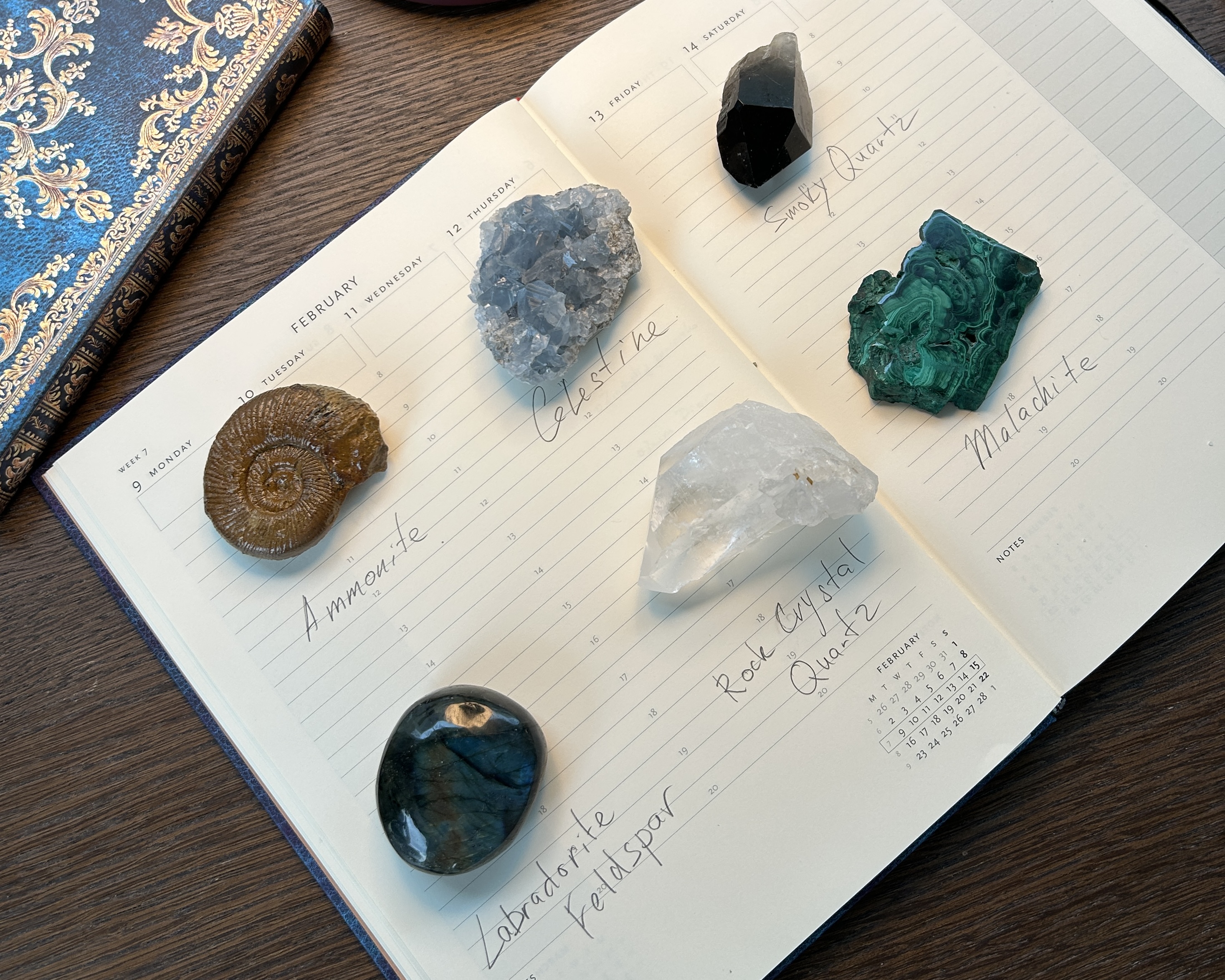
To illustrate the point: as soon as I saw Dior's posts, it took me just a minute to gather similar specimens from my own collection and recreate the same atmosphere. Labradorite, ammonite, celestine, malachite, smoky quartz, and rock crystal. Not because these are hard-to-find treasures, but precisely because they are the kind of beautiful, accessible minerals that any collector accumulates naturally over time. Building a personal mineral cabinet is one of the most rewarding hobbies one can have, and as Dior has just shown the world, it is also deeply inspiring.
The Eye Behind the Collection
Building a collection with aesthetic coherence and scientific integrity does not happen by accident. Behind every great mineral cabinet there is a trained eye, someone who understands not only the beauty of the specimens but their geological context, provenance, and quality. Professional mineralogists and gemologists can help identify and authenticate specimens, recommend acquisitions, and curate a collection that is both meaningful and visually compelling.
If Dior's Objects of Wonder has sparked your curiosity, consider this an invitation to explore. The mineral kingdom is vast, beautiful, and surprisingly accessible. And when you're ready to go deeper, a gemologist can be your best guide.
Olena Rybnikova | GemsLabé
Gemological Expertise and Consultancy